
Key Notes
- 1P-LSD is a prodrug of LSD, converting into LSD in the body [(1)].
- Mechanism: primarily 5-HT2A receptor agonism, with secondary roles for 5-HT1A, 5-HT2C, dopamine D2, and adrenergic receptors [(2), (3)].
- Potential therapeutic domains: depression, anxiety, PTSD, addiction, and palliative care—extrapolated from LSD/psilocybin studies [(4)].
- No clinical trials yet exist for 1P-LSD itself → all therapeutic claims are hypothetical.
- Safety/legal context: acute risks include anxiety and perceptual disturbances; legality varies worldwide [(5)].
- For context see Complete Guide to 1P-LSD, Pharmacology and Legal Status.
The Intersection of Psychedelic Science and 1P-LSD
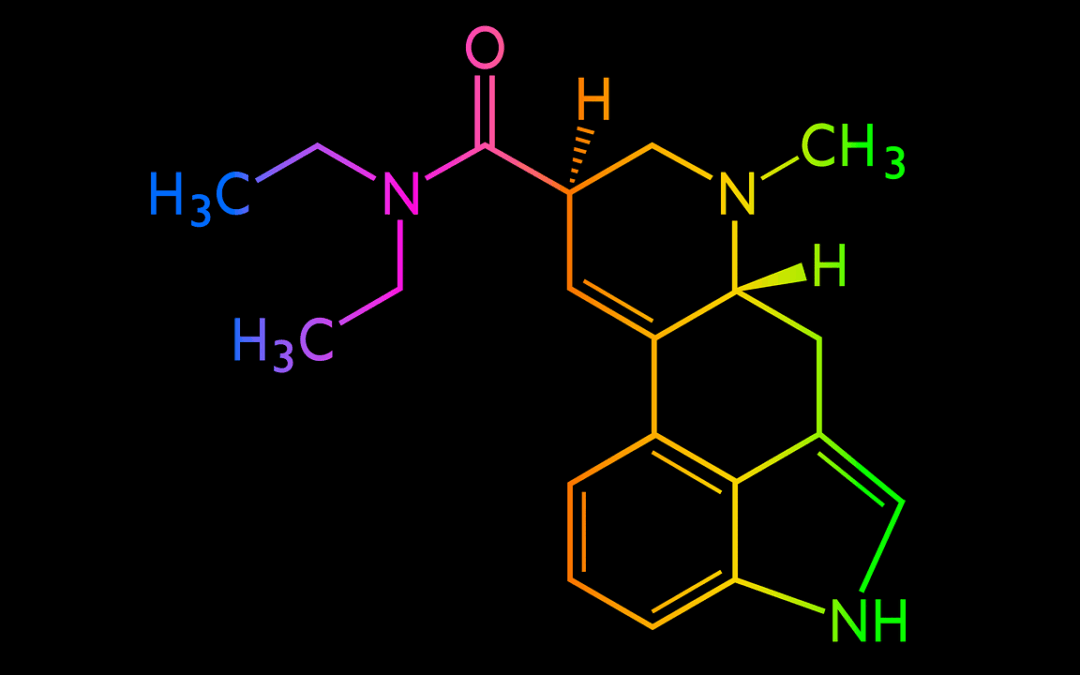
Psychedelic research has entered a renaissance over the past two decades, with compounds such as psilocybin, MDMA, and LSD attracting renewed interest from neuroscientists and psychiatrists. While many of these substances remain tightly regulated, analogues like 1P-LSD (1-propionyl-lysergic acid diethylamide) have emerged as valuable tools for exploring psychedelic mechanisms. Chemically related to LSD, 1P-LSD is classified as a prodrug, meaning it converts into LSD after metabolism. This makes it pharmacologically almost indistinguishable from LSD in terms of receptor activity and systemic effects.
The central question is whether 1P-LSD has potential therapeutic value, and if so, what insights psychedelic science provides into its possible clinical applications. Current data suggest that 1P-LSD, like LSD, acts primarily on the 5-HT2A receptor, which plays a pivotal role in shaping perception, cognition, and mood. Clinical trials of LSD itself have indicated benefits for anxiety, depression, and end-of-life distress, while psilocybin studies echo these findings. Although 1P-LSD has not yet been tested clinically, its pharmacological similarity positions it as a candidate for future exploration.
This blog post examines the potential therapeutic uses of 1P-LSD through the lens of psychedelic science, covering its mechanistic foundations, possible psychiatric applications, emerging hypotheses in neuroscience, and critical considerations for safety and legality. We also highlight where 1P-LSD fits within the broader psychedelic therapy landscape, connecting back to ongoing research on LSD and psilocybin. For researchers and clinicians, understanding these parallels can help anticipate the opportunities—and challenges—of working with this compound.
Mechanistic Foundations: Why 1P-LSD Could Support Therapy
The first step in evaluating 1P-LSD’s therapeutic promise lies in its mechanism of action. Because 1P-LSD is a prodrug of LSD, its effects in the body closely mirror those of LSD. Once metabolized, it binds to serotonin receptors, with 5-HT2A playing the dominant role. Stimulation of this receptor triggers a cascade of cortical activity changes, including increased glutamate release, altered thalamocortical signaling, and enhanced global connectivity across brain networks.
These neurobiological shifts are linked to key psychological phenomena reported in psychedelic states: heightened introspection, reduced rigid thinking, increased emotional openness, and experiences of ego-dissolution. Each of these outcomes has therapeutic implications. For example, reducing rigid negative thought patterns may help individuals with depression, while heightened emotional openness may benefit those undergoing psychotherapy for trauma.
Additionally, 1P-LSD may promote neuroplasticity. Preclinical studies on LSD and psilocybin have shown that psychedelics stimulate growth of dendritic spines and synaptic connections, potentially reversing stress-related neural atrophy. Although direct studies on 1P-LSD are lacking, its conversion into LSD suggests it could share these plasticity-enhancing properties. This makes 1P-LSD a candidate for conditions where maladaptive neural wiring underlies symptoms, such as post-traumatic stress disorder (PTSD) and substance use disorders.
Mechanistic overlap with LSD also indicates potential in palliative care. Psychedelics may reduce existential anxiety by altering perception of self and mortality. 1P-LSD’s predictable pharmacology and long duration may provide a therapeutic window suitable for guided sessions, though careful clinical design would be necessary.
Potential Psychiatric and Neurological Applications
Based on existing LSD and psilocybin research, several therapeutic domains emerge where 1P-LSD may hold promise:
1. Depression and Mood Disorders
Major depressive disorder (MDD) remains resistant to conventional treatment in many patients. Psychedelics like psilocybin have demonstrated rapid and sustained antidepressant effects in clinical trials. Given 1P-LSD’s conversion to LSD, similar outcomes could be anticipated. Enhanced emotional flexibility and shifts in default mode network activity may underlie these improvements.
2. Anxiety and End-of-Life Distress
LSD trials from the mid-20th century and modern psilocybin studies both suggest efficacy in reducing anxiety, particularly in patients facing terminal illness. 1P-LSD may replicate these benefits by fostering profound shifts in existential perspective, enabling patients to process fear of death with reduced distress.
3. Post-Traumatic Stress Disorder (PTSD)
Although MDMA has led the way in PTSD research, serotonergic psychedelics are also under consideration. By loosening rigid trauma-related memories and enhancing emotional processing, 1P-LSD may complement psychotherapeutic interventions aimed at trauma recovery.
4. Addiction and Substance Use Disorders
Preliminary studies with LSD in the 1960s showed reductions in alcohol misuse, and modern psilocybin research has demonstrated promise for tobacco and alcohol dependence. 1P-LSD could contribute to this field by disrupting compulsive behavior patterns and promoting new insights during therapy.
5. Neurological Conditions
Some neuroscientists hypothesize that psychedelics may have value in treating cluster headaches and migraine disorders, given anecdotal and preliminary clinical evidence with LSD and psilocybin. Whether 1P-LSD shares these effects remains unknown, but mechanistic similarity suggests it cannot be ruled out.
Future Research Directions and Broader Implications
One of the most important aspects of considering 1P-LSD’s therapeutic potential is identifying research priorities. Currently, psychedelic research is dominated by psilocybin and MDMA, which are further along in clinical development. However, there are reasons to include 1P-LSD in future programs. For example, its status as a prodrug of LSD means that it may be used as a proxy in regions where LSD is prohibited, enabling data collection that indirectly informs LSD research. This could accelerate understanding of how lysergamides work across populations and contexts.
Another implication relates to comparative pharmacology. By studying 1P-LSD alongside LSD and ALD-52, scientists may gain deeper insight into how structural modifications alter receptor binding and experiential quality. This knowledge could inform the design of next-generation psychedelics with optimized therapeutic profiles. Additionally, researchers may consider whether 1P-LSD has subtle differences in onset, duration, or subjective quality that could be clinically relevant. For example, a slightly delayed onset might allow more structured preparation before peak effects.
Finally, we must consider global policy shifts. Countries such as Australia and Canada are beginning to establish regulatory pathways for psychedelic therapy. If these frameworks expand, the question will arise whether 1P-LSD should be evaluated alongside psilocybin and LSD. Policymakers will need to balance public health concerns, research evidence, and ethical debates when determining whether to approve or restrict clinical trials involving this compound. The outcome will have lasting effects on how researchers view the entire class of lysergamides.
Integrating 1P-LSD into Psychedelic-Assisted Therapy Models
If clinical pathways open for 1P-LSD, integration into therapy would likely mirror protocols now being developed for psilocybin and MDMA. Patients would undergo careful screening and preparation, including evaluation for psychiatric vulnerabilities. During dosing sessions, therapists would provide a supportive environment, often with music and guidance. Afterward, structured integration sessions would help patients make sense of their experiences and translate insights into lasting behavioral change.
Such models emphasize that psychedelic therapy is not about the drug alone but about the interaction of compound, context, and guidance. If 1P-LSD were ever approved for research trials, these principles would ensure both safety and therapeutic efficacy. Importantly, therapists would need specialized training, as managing psychedelic states requires skills distinct from traditional talk therapy.
Safety, Legal, and Ethical Considerations
While therapeutic possibilities are intriguing, there are important limitations. First, no clinical trials have yet been conducted on 1P-LSD itself. All therapeutic speculations rely on extrapolations from LSD and psilocybin data. Second, safety concerns persist. Acute risks include anxiety, perceptual disturbances, and impaired judgment. Chronic risks, though rare, include hallucinogen persisting perception disorder (HPPD). As such, therapeutic use would require professional guidance, controlled settings, and rigorous protocols.
Legally, 1P-LSD occupies a gray or restricted status in many jurisdictions. In the UK and Germany, it is explicitly banned. In the US, it may be prosecuted under the Federal Analogue Act. For researchers, this means that institutional approval and compliance with local law are essential. Clinicians cannot currently prescribe or administer 1P-LSD outside approved studies.
Ethically, the question arises: should researchers pursue 1P-LSD when LSD and psilocybin already show efficacy? Proponents argue that legal ambiguity may allow some research progress in places where LSD is prohibited. Others suggest resources should focus on better-studied compounds. Ultimately, the decision will depend on evolving policy, scientific interest, and funding availability.
FAQs
1. Has 1P-LSD ever been used in clinical trials?
No. All therapeutic discussions are based on LSD and psilocybin trials. 1P-LSD remains a research chemical [(1)].
2. Could 1P-LSD help with depression?
Possibly, but indirectly inferred from psilocybin and LSD data showing antidepressant effects [(4)].
3. Is it safe to use 1P-LSD therapeutically?
Not outside research settings. Acute risks include anxiety, confusion, and physiological stress. Rarely, persistent perceptual disturbances occur [(3)].
4. Why use 1P-LSD instead of LSD?
Primarily because of legal ambiguity. In some regions, 1P-LSD is unscheduled where LSD is banned, making it easier for labs to study [(5)].
5. Can it be used in palliative care?
Hypothetically yes, given LSD’s history of reducing existential distress. Dedicated 1P-LSD trials are needed.
6. Could 1P-LSD treat PTSD?
Possibly, by loosening rigid trauma-related memory networks. Current evidence is extrapolated, not direct.
Where Does 1P-LSD Fit in Psychedelic Therapy?
The story of 1P-LSD underscores both the promise and the challenges of psychedelic science. Mechanistically, it offers nearly identical effects to LSD, making it a compelling candidate for therapeutic exploration. Its potential applications span mood disorders, PTSD, addiction, and palliative care, though all remain hypothetical without dedicated trials.
For now, 1P-LSD remains a research chemical. Its role is to provide insights into the pharmacology and therapeutic potential of lysergamides. Should legal landscapes evolve, future clinical trials could determine whether 1P-LSD has a place alongside psilocybin, MDMA, and LSD in the growing toolkit of psychedelic-assisted therapies.
👉 For broader context, see the Complete Guide to 1P-LSD, Pharmacology of 1P-LSD, and 1P-LSD Safety Profile.
References
- PubChem – 1P-LSD Compound Information
- NCBI – Serotonin Receptor Pharmacology
- PMC – The Pharmacology of LSD
- Frontiers – LSD & Psilocybin Human Trials
- EMCDDA – LSD Drug Profile
<script type="application/ld+json">
{
  "@context": "https://schema.org",
  "@graph": [
    {
      "@type": "BreadcrumbList",
      "@id": "https://chemicalroute.com/1p-lsd-therapeutic-uses#breadcrumbs",
      "itemListElement": [
        { "@type": "ListItem", "position": 1, "name": "Home", "item": "https://chemicalroute.com/" },
        { "@type": "ListItem", "position": 2, "name": "1P-LSD Guide", "item": "https://chemicalroute.com/1p-lsd" },
        { "@type": "ListItem", "position": 3, "name": "Potential Therapeutic Uses of 1P-LSD", "item": "https://chemicalroute.com/1p-lsd-therapeutic-uses" }
      ]
    },
    {
      "@type": "Article",
      "@id": "https://chemicalroute.com/1p-lsd-therapeutic-uses#article",
      "mainEntityOfPage": "https://chemicalroute.com/1p-lsd-therapeutic-uses",
      "headline": "Potential Therapeutic Uses of 1P-LSD: Insights from Psychedelic Science",
      "description": "Long-form review of 1P-LSD’s potential therapeutic applications—depression, anxiety, PTSD, addiction, and palliative care—grounded in psychedelic science and extrapolated from LSD/psilocybin research.",
      "image": [ "http://chemicalroute.com/wp-content/uploads/2025/09/chemistry-2991157_12801.png" ],
      "author": { "@type": "Person", "name": "CHEMICAL ROUTE" },
      "publisher": {
        "@type": "Organization",
        "name": "CHEMICAL ROUTE",
        "logo": { "@type": "ImageObject", "url": "http://chemicalroute.com/wp-content/uploads/2021/01/logo-resize.png" }
      },
      "datePublished": "2025-09-29T00:00:00-06:00",
      "dateModified": "2025-09-29T00:00:00-06:00",
      "inLanguage": "en",
      "isPartOf": {
        "@type": "WebSite",
        "@id": "https://chemicalroute.com/#website",
        "name": "CHEMICAL ROUTE",
        "url": "https://chemicalroute.com"
      },
      "about": [
        { "@type": "Thing", "name": "1P-LSD" },
        { "@type": "Thing", "name": "Psychedelic therapy" },
        { "@type": "Thing", "name": "Serotonin 5-HT2A receptor" },
        { "@type": "Thing", "name": "Neuroplasticity" },
        { "@type": "Thing", "name": "Palliative care" }
      ],
      "articleSection": [
        "Introduction",
        "Mechanistic Foundations",
        "Potential Psychiatric and Neurological Applications",
        "Future Research & Therapy Models",
        "Safety, Legal, and Ethical Considerations",
        "Conclusion"
      ],
      "keywords": [
        "1P-LSD therapeutic uses",
        "1P-LSD depression",
        "1P-LSD PTSD",
        "psychedelic-assisted therapy",
        "lysergamides",
        "5-HT2A",
        "neuroplasticity"
      ]
    },
    {
      "@type": "FAQPage",
      "@id": "https://chemicalroute.com/1p-lsd-therapeutic-uses#faq",
      "mainEntity": [
        {
          "@type": "Question",
          "name": "Has 1P-LSD been tested in clinical trials?",
          "acceptedAnswer": {
            "@type": "Answer",
            "text": "No. There are no registered clinical trials for 1P-LSD to date. Therapeutic hypotheses are extrapolated from LSD and psilocybin research; 1P-LSD is considered a research chemical."
          }
        },
        {
          "@type": "Question",
          "name": "What mechanisms could make 1P-LSD therapeutically useful?",
          "acceptedAnswer": {
            "@type": "Answer",
            "text": "After in vivo conversion to LSD, partial agonism at 5-HT2A and secondary activity at 5-HT1A/2C, dopamine D2, and adrenergic receptors may promote cognitive flexibility, emotional processing, and neuroplasticity."
          }
        },
        {
          "@type": "Question",
          "name": "Which conditions are theoretically promising for 1P-LSD?",
          "acceptedAnswer": {
            "@type": "Answer",
            "text": "Based on psychedelic science, potential domains include depression, anxiety (including end-of-life distress), PTSD, addiction, and possibly certain neurological pain syndromes. These remain hypotheses pending trials."
          }
        },
        {
          "@type": "Question",
          "name": "Is it safe to use 1P-LSD in therapy?",
          "acceptedAnswer": {
            "@type": "Answer",
            "text": "Outside approved research, no. Acute risks include anxiety, confusion, and perceptual disturbances; rare persistent effects have been reported with serotonergic psychedelics. Any future use would require controlled settings and trained clinicians."
          }
        },
        {
          "@type": "Question",
          "name": "Why consider 1P-LSD if LSD and psilocybin are being studied?",
          "acceptedAnswer": {
            "@type": "Answer",
            "text": "In some jurisdictions, 1P-LSD’s legal status may allow limited research access where LSD is restricted, offering a proxy to investigate lysergamide mechanisms under ethical approvals."
          }
        },
        {
          "@type": "Question",
          "name": "Can clinicians prescribe 1P-LSD today?",
          "acceptedAnswer": {
            "@type": "Answer",
            "text": "No. 1P-LSD is not an approved medicine and is generally unavailable for clinical use. Any handling should be for research purposes only, in compliance with local laws and institutional oversight."
          }
        }
      ]
    }
  ]
}
</script>
Recent Comments