
Description
AL-LAD
Product information
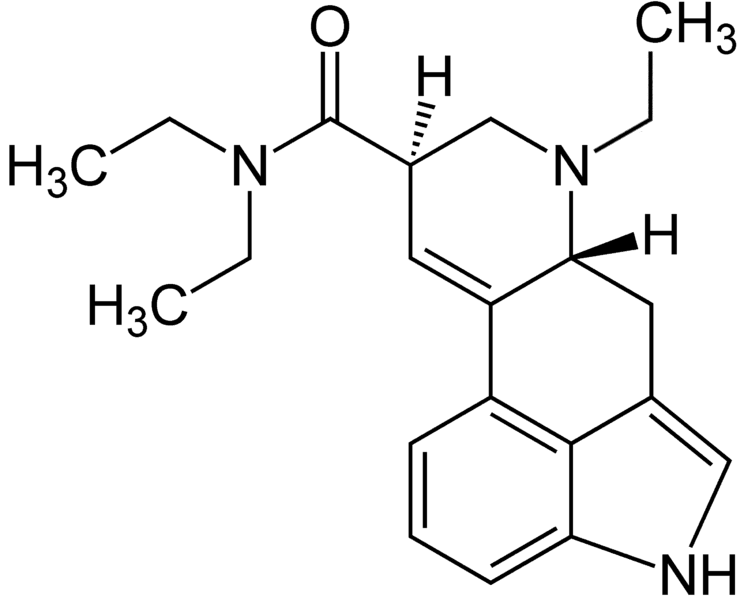
IUPAC-name (6aR,9R)-N,N-diethyl-7-prop-2-enyl-6,6a,8,9-tetrahydro-4H-indolo[4,3-fg]quinoline-9-carboxamide
Synonyms ALLAD; AllylLAD; Allyl-LAD; ALLYLAD; AllyLAD; ALLY-LAD;
Formal name 6-Allyl-6-nor-LSD; 6-Allyl-6-nor-N,N-diethyllysergamide; 9,10-Didehydro-6-allyl-N,N-diethylergoline-8β-carboxamide
Cas number 65527-61-9
Formula C22H27N3O
Molar mass 349.478 g·mol−1
Formulation Appearance Blotters
Shipping & Storage Information
AL-LAD: A Complete Guide to the LSD Analog
- AL-LAD (6-allyl-6-nor-lysergic acid diethylamide) is a synthetic lysergamide, structurally related to LSD, first synthesized in the 1970s and studied systematically by Andrew Hoffman and David Nichols in 1984 [1].
- It shares LSD’s core ergoline structure but has an allyl group at the N6 position instead of a methyl group [1][2].
- Like LSD, it acts primarily as a serotonin 5-HT2A receptor agonist, which is believed to underlie its psychedelic effects [3].
- AL-LAD is unscheduled by name in the United States but is treated as a controlled analog of LSD under the Federal Analogue Act when intended for human consumption [3].
- It is explicitly a Class A controlled substance in the United Kingdom and is separately controlled in Germany, Switzerland, Sweden, Denmark, and other jurisdictions [3][4].
- Forensic and analytical chemists continue to study AL-LAD and its derivatives (such as 1cP-AL-LAD) because new, unregulated lysergamide variants keep appearing on the novel psychoactive substance (NPS) market [5][6].
- Human safety data remain limited; most information comes from analytical chemistry, animal studies, and user self-reports rather than controlled clinical trials [2][6].
- This guide is for informational and research purposes; it does not provide dosing, synthesis, or acquisition guidance.
What Is AL-LAD and Why Does It Matter?
AL-LAD — formally 6-allyl-6-nor-lysergic acid diethylamide, and also known by the shorthand “Aladdin” in online drug-user communities — belongs to a family of compounds called lysergamides, which share a core chemical skeleton with lysergic acid diethylamide (LSD). AL-LAD is not LSD, but it is close enough in structure that regulators, chemists, and drug-checking services treat it as part of the same conversation about lysergamide-class novel psychoactive substances (NPS) [1][3].
The compound is scientifically interesting for three overlapping reasons. First, it has genuine medicinal-chemistry history: Purdue University researchers Andrew Hoffman and David Nichols synthesized and characterized AL-LAD in 1984 as part of a structured effort to understand how small changes to the LSD molecule affect its activity at serotonin receptors [1]. Second, it later became one of many “legal high” lysergamides sold online starting around 2013, alongside compounds such as 1P-LSD, ALD-52, and ETH-LAD, marketed to skirt drug laws that named LSD specifically but not its analogs [1][7]. Third, and most recently, AL-LAD and its own derivatives (like 1cP-AL-LAD) have become recurring subjects of forensic and toxicological research, because law enforcement and public health agencies need reliable ways to identify these substances in seized blotter paper, powders, and other exhibits [5][6].
Understanding AL-LAD, in other words, is really about understanding a broader pattern: how a single well-known psychoactive scaffold (the ergoline/lysergamide core of LSD) keeps generating new variants, how scientists tell them apart, and how the law tries to keep pace. This pillar page walks through AL-LAD’s chemistry, how it appears to work in the body, where it fits among other lysergamides, what is and is not known about its risks, its legal status around the world, and the questions people most commonly ask about it. Five companion cluster articles linked throughout this page go into much greater depth on specific sub-topics: a head-to-head comparison with LSD, the compound’s discovery history, a country-by-country legal breakdown, its receptor pharmacology, and the forensic science used to detect it.
This page is written for students, researchers, journalists, harm-reduction professionals, and curious readers. It is not a guide to using AL-LAD, and it deliberately omits dosing ranges, preparation methods, and sourcing information, none of which are appropriate for a public educational resource.
It is also worth being upfront about what kind of source base this guide draws on, and why that matters for how confidently any given claim should be read. Information about AL-LAD comes from a narrower and more uneven set of sources than information about a long-approved medicine or a decades-studied classic psychedelic like LSD. On the strong end of that spectrum sit peer-reviewed analytical chemistry and forensic toxicology journal articles, which have directly characterized AL-LAD and several of its derivatives using rigorous laboratory methods. In the middle sit structure-activity relationship studies and pharmacological evaluations, some dating back to the 1980s and 1990s, which remain the primary basis for understanding how AL-LAD interacts with the body. On the weaker end sit self-reported user experiences and secondary compilations, which can be useful for understanding perception and market history but should not be treated as equivalent to controlled clinical data. This guide flags which category each claim falls into wherever it matters, and its companion cluster articles go into considerably more depth on each of these evidentiary tiers.
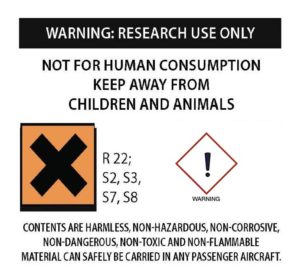
WARNING This product is not for human or veterinary use.
This product is only available to persons of 21 years old and above.
Hazard statement(s)
| H302 | Harmful if swallowed |
| H315 | Causes skin irritation |
| H319 | Causes serious eye irritation |
| H332 | Harmful if inhaled |
| H335 | cause respiratory irritation |
| H336 | cause drowsiness or dizziness |
| Precautionary statement(s) | |
| P264 | Wash hands thoroughly after handling |
| P280 | protective gloves/protective clothing/eye protection/face protection |
| P305 + P351 + P338 | IF IN EYES: Rinse cautiously with for several minutes. Remove contact lenses, if present and easy to do. Continue rinsing. |
| P337 + P313 | If eye irritation persists: Get medical advice/attention |
| P261 | Avoid breathing dust/ fume/ gas/ mist/ vapors/ spray |
| P271 | Use only outdoors or in a well-ventilated area |
| P304 + P340 | IF INHALED: Remove victim to fresh air and keep at rest in a position comfortable for breathing |
| P312 | Call a POISON CENTER or doctor/physician if you feel unwell |
| P403 + P233 | Store in a well-ventilated place. Keep container tightly closed |
| P405 | Store locked up |
| P501 | Dispose of contents/container to a licensed disposal company |
Reviews
There are no reviews yet.